The Finnish Museum of Photography wants to act responsibly in terms of environmental sustainability. Environmental sustainability encompasses many aspects of responsibility, such as equality, which is linked to safer space principles. Responsibility is one of the museum's core values.
This page describes the museum's efforts to reduce the environmental impact of its operations.
Property maintenance, waste management, and energy
The majority of the museum's exhibition and collection spaces are located at the Cable Factory in Helsinki. The Cable Factory participates in the Ekokompassi system and is committed to reducing carbon dioxide emissions and environmental impact in its operations, as well as promoting the circular economy. The electricity used at Kaapelitehdas is certified wind power.
The Cable Factory recycles paper, bio waste, cardboard, glass, metal, and plastic. The Cable Factory also has a recycling room where the building's occupants can exchange usable items with each other.
Exhibitions
New spatial elements are rarely constructed for exhibitions at the museum. The same modular walls and display cases have been in use for around 20 years. Unnecessary painting of walls is also avoided.
When producing exhibition prints, the most ecological solution is considered on a case-by-case basis. For example, having new prints made in Helsinki may sometimes be better for the climate than transporting finished works from far away. Long-lasting interchangeable frames are used for framing.
When works are packed for transport, clean protective materials are saved and reused.
Disposable printed materials are rarely produced for exhibitions.
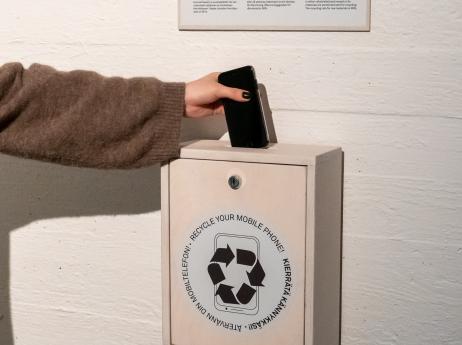
The Viewfinder exhibition has a permanent mobile phone recycling point and an information package on the environmental impact of mobile phones.
Collections
Proper storage of photographic collections requires precise control of air temperature and humidity, which consumes electricity. For this reason, materials in storage are packed in a space-saving manner.
The importance of sustainable development has also been emphasized thematically in collection work. For example, in 2019, the museum participated in the contemporary documentation project of the museum archiving cooperation network TAKO, which aimed to preserve contemporary cultural phenomena related to sustainable development themes in museums. The Museum chose to document young people's expression of climate concerns in photographic art, and the subject of the documentation was the exhibition Viimeinen sukupolvi (The Last Generation) by the museum's youth group Photofuss.
Additional activities
Museum staff travel to work almost exclusively by public transport or bicycle.
Fair trade tea, coffee, and wine, locally produced oat milk, and primarily plant-based ingredients are used in the museum staff facilities and at guest events.
Developing sustainable travel as part of the Sustainable Travel Finland program
The Finnish Museum of Photography has begun developing sustainable travel by joining Visit Finland's Sustainable Travel Finland (STF) program. The purpose of the STF program is to support tourism operators in planning, measuring, and developing their sustainability efforts in the long term.
Participation in the STF program means that we are committed to evaluating and developing our operations in terms of environmental responsibility. This is a long-term development process through which we will gradually strengthen our responsible practices.
In November 2025, the museum was awarded the Good Travel Seal sustainability certificate, which promotes sustainable development within the tourism sector. The certificate is maintained and supervised by the international organization Green Destinations.
In February 2026, the museum received the Sustainable Travel Finland label. The label is granted to organizations who have demonstrated valuable and long-term commitment to advancing sustainable tourism. The Finnish Museum of Photography is dedicated to implementing and promoting Visit Finland’s principles of sustainable tourism in all its activities.
The museum is committed to continuing its sustainability work in accordance with the action plan developed within the STF program. In 2026–2027, the museum will, among other measures, calculate its operational carbon footprint and develop and adopt procurement guidelines to ensure ecological and ethical purchasing practices.